"Myopia is the result of a combination of genetic and environmental factors, with environmental factors playing a crucial role in the development of myopia in children and adolescents" is a consensus in the academic community. The main environmental risk factors associated with myopia include work tasks involving excessive nearsightedness and insufficient outdoor exposure time. Nearsightedness activities involve working at a close distance (<20 cm) and prolonged periods of continuous close-range work (>30 minutes).
1. Division of myopia stages
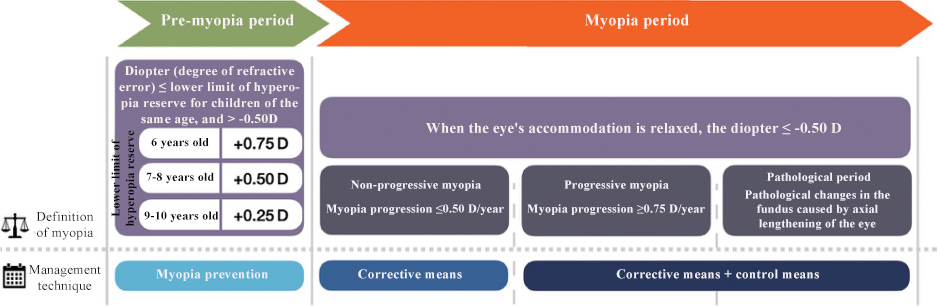
Different stages of myopia progression in children and adolescents require different management strategies under standardized monitoring, including correction and control of myopia in children and adolescents. Preventing myopia in children and adolescents in the pre-myopia stage—meaning those who have not yet developed myopia but have risk factors for myopia or whose eye growth rate indicates a higher risk of myopia. Research suggests that the age-related hyperopia reserve is the best predictor of myopia development and can be used for myopia prediction in children and adolescents in the early stages of myopia. Based on the White Paper on Myopia Management (2019) and the Asian Myopia Management Consensus, the classification of myopia stages in school-age children and adolescents aged 6 and above can be seen in Figure 1.
2. Myopia-related risk factors
"Myopia is the result of a combination of genetic and environmental factors, with environmental factors playing a crucial role in the development of myopia in children and adolescents[7]" is a consensus in the academic community. The main environmental risk factors associated with myopia include work tasks involving excessive nearsightedness and insufficient outdoor exposure time. Working at close range, being too close to the eyes (<20 cm) [8] and working at close range for a prolonged period of time (>30 min) [9] are the most relevant factors associated with the development of myopia. Increasing effective outdoor exposure time is an independent protective factor in preventing the occurrence of myopia [10]. In recent years, with the development of intelligent wearable device technology, various devices have been invented to objectively monitor close-range work and outdoor exposure, such as: head-mounted ultrasonic rangefinder [11] and RangeLife [12] for monitoring work distance; HOBO [13], Actiwatch [14], and FitSight [15] for monitoring outdoor exposure time; Cloud Clip and other devices for comprehensive quantification of close-range work and outdoor exposure [16]. The pathogenic genes and susceptible genes related to myopia are clear genetic risk factors. In addition, East Asian ethnicity, parental myopia, and female gender are also widely regarded as genetic risk factors for myopia [17].